
Shockwave therapy · Midtown Manhattan
Shockwave therapy, used with clinical precision.
Focused and radial shockwave for stubborn tendon, soft-tissue, and performance-limiting conditions—integrated into a complete rehabilitation plan.
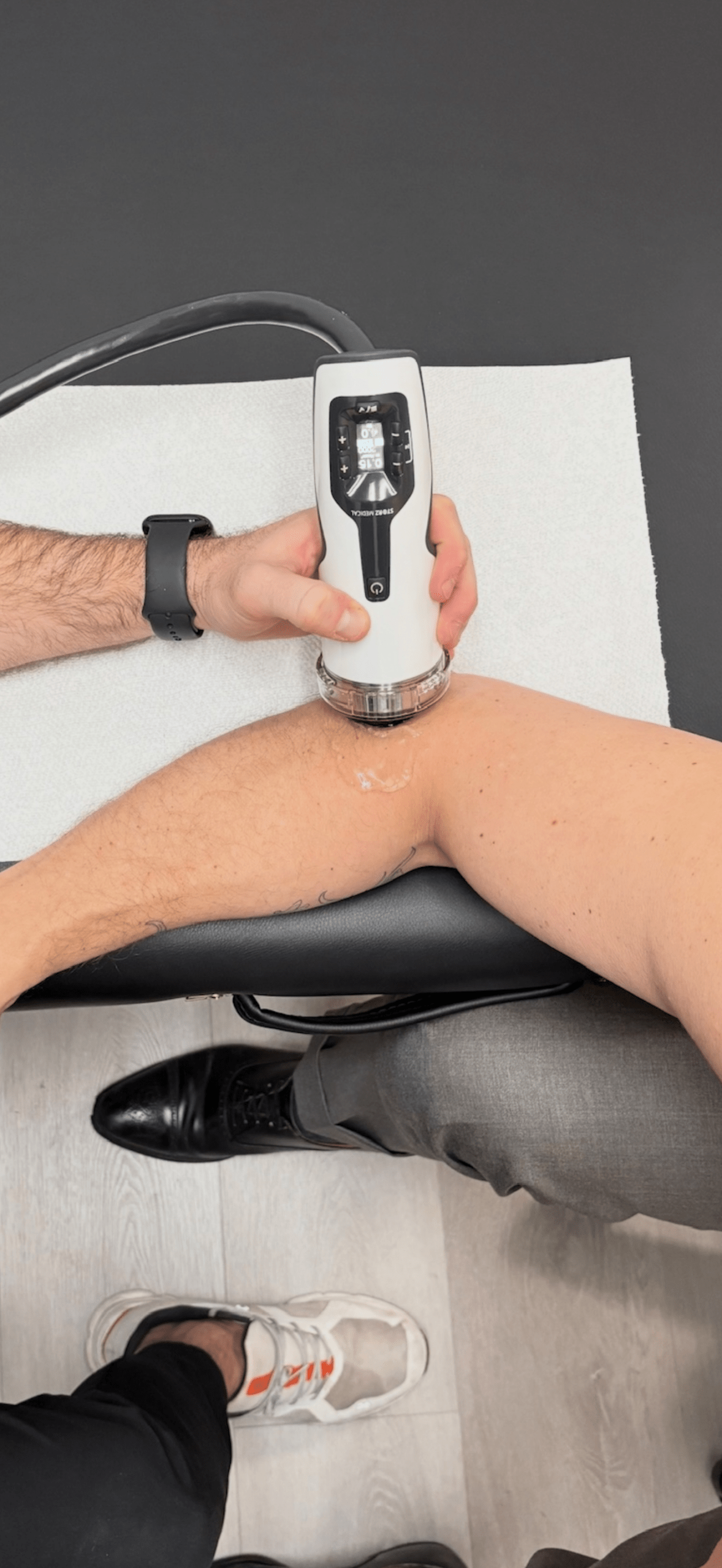
A focused approach
More than a stand-alone treatment.
At CityIR, shockwave therapy is used when it fits the clinical picture—not as a generic add-on. We evaluate the movement, tissue, and loading problem first, then integrate focused or radial shockwave with hands-on care and rehabilitation when appropriate.
The principle
Shockwave stimulates a natural repair response in tissue. The larger goal is to address both the irritated structure and the reason it keeps being overloaded.
What it is
Acoustic energy that supports tissue repair.
Shockwave therapy—also called extracorporeal shockwave therapy (ESWT) or acoustic wave therapy—uses controlled acoustic energy to reach injured tissue and stimulate the body’s cellular repair activity.
It is non-invasive and is widely used in orthopedic and sports medicine for persistent tendon, muscle, joint, and calcification-related problems, especially when rest, medication, injections, or standard physical therapy have reached their limits.
The difference
Repair-oriented care, not temporary masking.
The treatment is intended to support the biology of healing while the rehabilitation plan restores strength, control, and tolerance. Response varies by diagnosis, tissue condition, and individual factors.
The science
How shockwave therapy works.
A handheld device delivers acoustic waves into the treatment area. These pressure pulses stimulate repair activity instead of simply numbing symptoms.
Stimulates blood flow
Improves microcirculation, delivering oxygen and nutrients that support tissue repair.
Addresses calcification
Focused pressure waves may help break down calcium deposits contributing to chronic pain and restricted motion.
Supports cellular repair
Encourages collagen remodeling and a more durable healing response at the injury site.
See it in action
Shockwave therapy in practice.
Watch how radial and focused ESWT are applied during a typical treatment session.
Focused & radial
Two tools. One clinical goal.
We match the technology, depth, dosage, and protocol to the condition—not every patient to the same device.
Focused shockwave
Deeper, targeted energy
Precise delivery for deeper tendon, joint, bone, calcification, and select regenerative protocols.
Radial shockwave
Broader soft-tissue treatment
Useful for larger treatment zones, superficial tendon and muscle conditions, trigger points, and fascia.
Why CityIR
Technology guided by examination.
No downtime
Most patients walk in, receive treatment, and return to their day.
Integrated care
Shockwave is paired with the rehabilitation work needed for lasting change.
Experienced clinicians
Your provider selects and adjusts the protocol directly—there is no generic handoff.
Clinical outcomes
Real cases. Clear treatment decisions.
Back on the court after eight months of heel pain
- Problem
- Pickleball 4–5 times weekly; orthotics, cortisone, and months of stretching had failed, with surgery suggested next.
- Treatment
- Five focused sessions at the plantar fascia origin, paired with corrective gait work.
- Outcome
- Pain-free within four weeks and back to full court sessions without surgery.
Relief after six months of failed treatment
- Problem
- Typing, mousing, and carrying were painful; rest, NSAIDs, a strap, and two months of PT had failed.
- Treatment
- Six focused sessions at the lateral epicondyle plus progressive eccentric loading.
- Outcome
- Full resolution and return to normal work and weekend tennis.
Back to league basketball after a year of knee pain
- Problem
- Chronic tendon pain limited play, while medication and four months of PT had plateaued.
- Treatment
- Four focused sessions combined with a progressive loading plan.
- Outcome
- Full league return within six weeks, pain-free, with no recurrence at eight months.
Surgery recommended. Surgery avoided.
- Problem
- A year of shoulder pain and an MRI-confirmed partial supraspinatus tear led to a surgical recommendation.
- Treatment
- Six focused sessions plus scapular stabilization and progressive strength work.
- Outcome
- Pain resolved, overhead motion returned, and surgery was no longer indicated.
What to expect
A short treatment. A structured plan.
Shockwave is performed in-office and does not require anesthesia or downtime for most patients.
Diagnosis & assessment
We determine whether shockwave is appropriate for your condition.
Treatment sessions
Typically 4–6 visits of 15–20 minutes. Mild discomfort is normal; anesthesia is not needed.
No recovery time
Most patients resume normal activity immediately and exercise within 24–48 hours.
Progressive improvement
Some notice early change; full results commonly develop over 6–12 weeks.
Conditions we treat
Where shockwave may fit.
Suitability depends on the diagnosis, tissue, and stage of healing. The evaluation determines the right approach.
Tendon injuries & tears
- Partial rotator cuff tears
- Achilles tendinopathy
- Tennis elbow
- Golfer’s elbow
- Patellar tendinopathy
- Bicipital tendinitis
Muscle & soft tissue
- Muscle strains
- Trigger points
- Myofascial pain
- IT band syndrome
- Hamstring injuries
- Quadriceps and calf strains
Persistent pain & calcification
- Frozen shoulder
- Plantar fasciitis
- Shin splints
- Calcific shoulder
- Chronic tendinosis
- Stress fractures
Joint & bursa conditions
- Hip bursitis
- Shoulder bursitis
- Knee bursitis
- Knee osteoarthritis
- Hip arthritis
- Post-surgical scar tissue
Compare approaches
A non-invasive option before surgery.
Treatment choices depend on the diagnosis, severity, health history, goals, and available evidence. This comparison is general education—not a substitute for an individual recommendation.
| Condition | Shockwave | Surgery | Cortisone |
|---|---|---|---|
| Partial rotator cuff tear | 3–6 sessions; minimal downtime | Often months of recovery | Temporary relief; repeated use may weaken tendon |
| Plantar fasciitis | 3–6 sessions; walk the same day | May require prolonged protected weight-bearing | Short-term relief; tissue risks with repetition |
| Tennis elbow | 3–5 sessions; quick activity return | Often 4–6 months of recovery | May not provide durable improvement |
| Calcific shoulder | May address calcium non-invasively | Arthroscopic removal and rehabilitation | Does not remove calcification |
Investment
Clear costs before care begins.
Transparent pricing
Every cost is discussed before treatment. Coverage varies by plan and diagnosis; our team will explain your options before you commit.
Payment options
Monthly payment options may be available through Cherry, including promotional 0% APR when offered and approved.
FAQ
What patients ask before starting.
Is shockwave painful?
Most patients feel tapping or pressure. Intensity is adjustable and anesthesia is generally unnecessary.
How many sessions will I need?
Many protocols use 4–6 weekly sessions, adjusted to your diagnosis and response.
When will I notice results?
Some patients notice change within 1–3 sessions; tissue remodeling can continue for 6–12 weeks.
Are there side effects?
Temporary redness, swelling, tenderness, or soreness may occur for 24–48 hours.
Is it the same as ultrasound or TENS?
No. Shockwave uses acoustic pressure waves intended to stimulate a repair response.
Who should not receive shockwave therapy?
Shockwave is not appropriate for every person or treatment area. Pregnancy, active infection, tumors in the treatment area, certain bleeding or clotting concerns, and some medications or medical conditions require specific screening. Your clinician will review your history and the proposed treatment site before recommending care.
Right fit
Are you a candidate?
Shockwave may be appropriate when persistent musculoskeletal pain has not responded to more conservative care.
Book an evaluation →Symptoms lasting more than six weeks
Persistent heel, shoulder, elbow, knee, tendon, or soft-tissue pain.
Standard care has plateaued
Rest, medication, injections, or rehabilitation have not produced lasting relief.
You want a non-invasive option
The goal is to improve tissue capacity before considering surgery where appropriate.
Your health history has been screened
We review the diagnosis, treatment area, medications, and relevant precautions before recommending shockwave.
Keep exploring
Related shockwave resources.
Start here
Begin with the right evaluation.
We’ll determine whether focused shockwave, radial shockwave, rehabilitation—or another approach—best fits your condition.
Midtown Manhattan
City Integrative Rehabilitation420 Madison Ave #803
New York, NY 10017
Ready to start your recovery?
Book an Appointment Great Neck: (516) 418-3798 Manhattan: (646) 256-9513 Huntington: (631) 659-2980Nesconset: (631) 584-8783