The Gold Standard in Non-Surgical Disc Treatment.
FDA-cleared and backed by 9 peer-reviewed studies, VAX-D (Vertebral Axial Decompression) is the most clinically researched spinal decompression system in the world — trusted by neurosurgeons and orthopedists nationwide. Our West Hills location is home to three VAX-D tables — more than any other practice on Long Island.
Book an AppointmentNot All Decompression Is Equal
Many clinics offer "spinal decompression" using generic traction tables or low-cost imitation devices. These are not the same as VAX-D.
VAX-D (Vertebral Axial Decompression) was developed by Dr. Allan Dyer, a former Deputy Minister of Health of Ontario, and is the only decompression device shown in clinical research to reduce intradiscal pressure to negative levels — actually creating a vacuum effect that draws herniated disc material back into place and promotes nutrient flow to damaged discs.
With 9 peer-reviewed published studies — more than any other decompression system — VAX-D is the device that neurosurgeons, orthopedists, and professional sports teams trust when their patients need a real alternative to surgery.
VAX-D vs. Generic Decompression vs. Surgery
How the authentic VAX-D table compares to generic decompression devices and traditional surgical treatment for disc-related pain.
| VAX-D (Authentic) | Generic Decompression | Surgery (Discectomy / Fusion) | |
|---|---|---|---|
| Peer-Reviewed Research | 9 published studies in major medical journals | No peer-reviewed studies on most devices | Extensive research, but high variability in outcomes |
| Intradiscal Pressure | Documented reduction to −150 mmHg (vacuum effect) | Traction devices have not demonstrated negative pressure | Physical removal of disc material; permanent structural change |
| Invasiveness | Non-invasive, no anesthesia, walk in / walk out | Non-invasive | Invasive surgery with anesthesia and hospitalization |
| Recovery Time | None. Return to activity immediately. | None | 4–6 months typical for fusion; weeks for discectomy |
| Risks & Complications | Minimal. No known serious side effects. | Minimal, but results are inconsistent | Scar tissue, infection, failed back surgery syndrome, adjacent segment disease |
| Typical Treatment Plan | 15–20 sessions over 5–7 weeks | Varies; often fewer sessions with weaker results | One procedure + months of post-op rehab |
| Long-Term Outcome | 71% success rate across 778 patients (Neurological Research, 1998) | Variable outcomes; limited outcome data | Failed back surgery syndrome reported in 10–40% of patients |
Comparisons reflect published clinical research and are intended to aid patient decision-making alongside medical consultation. Individual results vary.
How VAX-D Works
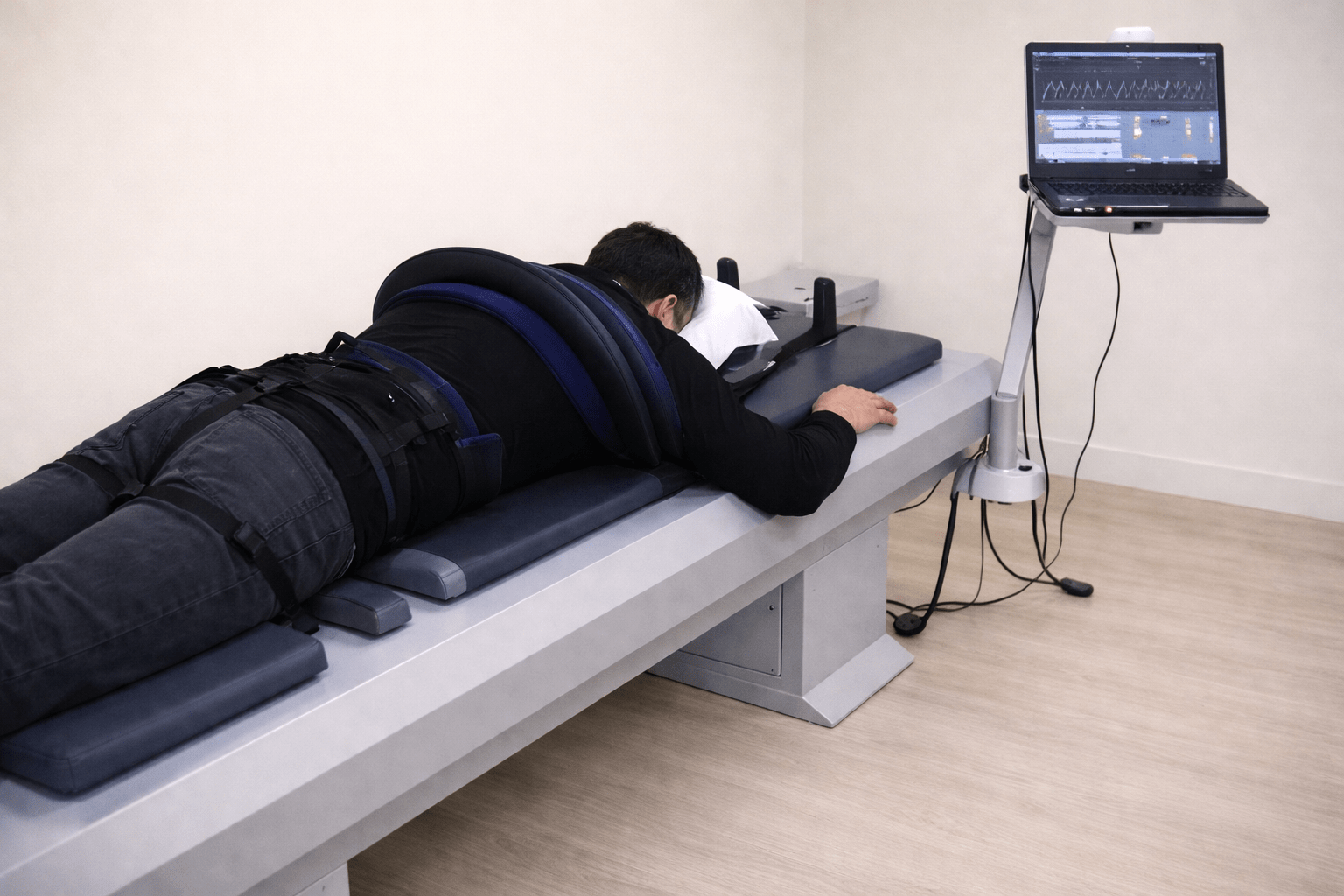
During each session, you lie face down on the VAX-D table. A patented, computerized logarithmic pull curve gently separates the vertebrae at the targeted disc level — a precise pattern that bypasses muscle guarding to reach deep into the disc space. Research in the Journal of Neurosurgery has shown VAX-D reduces intradiscal pressure from a resting +25 mmHg to as low as &minus:150 mmHg, creating a vacuum effect.
Retracts Disc Material
The vacuum effect draws herniated or bulging disc material back toward the center — addressing the structural cause of nerve compression.
Relieves Nerve Pressure
As disc material retracts, pressure on compressed spinal nerves is reduced — often resolving the radiating leg or arm pain that comes with disc-related conditions.
Restores Nutrient Flow
Negative pressure pulls oxygen, nutrients, and fluids into damaged discs — supplying the building blocks the body needs to heal.
Triggers Natural Healing
The combination of decompression and improved circulation promotes your body's own healing response — without drugs, injections, or surgery.
Sessions typically last 20–30 minutes. Most patients find the treatment comfortable — many even fall asleep during the procedure.
The Authentic VAX-D Table at West Hills

The authentic VAX-D table at our West Hills office — the same FDA-cleared device used in the published clinical studies.
At CityIR, our West Hills office features the authentic VAX-D table — the same FDA-cleared device used in the published clinical studies. VAX-D's patented technology delivers precise, computer-controlled axial distraction forces that no imitation device can replicate.
- Patented logarithmic distraction curve that bypasses muscle guarding
- The only device clinically proven to achieve negative intradiscal pressure
- Real-time force monitoring with programmable treatment protocols
- Used by NBA, NFL, NHL, and Olympic athletes for disc-related injuries
- 9 published peer-reviewed studies — more than any other decompression device
The DRX9000

In addition to the VAX-D, our West Hills clinic also features the DRX9000 — another advanced, FDA-cleared spinal decompression system. Patients benefit from having access to multiple high-tech treatment options, allowing us to tailor your decompression therapy for the best possible results.
Looking for decompression closer to Long Island's North Shore? Our Great Neck location offers non-surgical spinal decompression using the Chattanooga Triton DTS.
Why VAX-D Over Surgery?
Surgery should be a last resort — not a first option. VAX-D offers a proven, non-invasive alternative with significant advantages over surgical disc procedures.
Non-Invasive
No incisions, no anesthesia, no hospital stays. Treatment is performed in our office with zero downtime.
No Medication Dependency
VAX-D addresses the structural cause of your pain rather than masking symptoms with painkillers or anti-inflammatories.
Clinically Proven
Published research across multiple studies shows VAX-D provides significant relief for the majority of patients — one multi-center study of 778 patients reported a 71% success rate.
Integrated Care
At our West Hills location, decompression is paired with chiropractic adjustments, rehabilitation exercises, and soft-tissue work — maximizing results and preventing recurrence.
Conditions VAX-D Treats
VAX-D is a primary non-surgical treatment for patients with disabling low-back and neck pain from disc-related conditions.
Disc Herniations
- Bulging discs
- Protruded discs
- Ruptured discs
- Extruded disc material
Degenerative Disc Disease
- Chronic low back pain
- Disc height loss
- Facet joint syndrome
- Age-related disc degeneration
Nerve Compression
- Sciatica
- Lumbar radiculopathy
- Cervical radiculopathy
- Pinched nerves
Failed Back Surgery
- Post-surgical pain (FBSS)
- Persistent pain after fusion
- Pain after discectomy
- Scar tissue discomfort
Spinal Stenosis
- Lumbar stenosis
- Foraminal narrowing
- Leg pain with walking
- Neurogenic claudication
Chronic Back Conditions
- Chronic low back pain
- Neck pain from disc issues
- Facet arthropathy
- Pain unresolved by PT
Not sure if your condition qualifies? Schedule an evaluation and we’ll review your imaging and history to determine if VAX-D is right for you.
The Research Behind VAX-D
VAX-D is backed by 9 published, peer-reviewed studies — more than any other spinal decompression device. Here are four of the key findings.
Intradiscal Pressure Study
Demonstrated that VAX-D reduces intradiscal pressure to −150 mmHg — creating a true vacuum effect within herniated discs. This is the foundational study proving the mechanism behind VAX-D's effectiveness.
Multi-Center Outcome: 778 Patients
Data collected across 22 medical centers showed a 71% success rate (pain reduced to 0 or 1 on a 0–5 scale) in 778 patients treated with VAX-D for herniated, bulging, and degenerated discs.
Mayo Clinic Multi-Center Study
A multi-center pilot study presented at the American Academy of Pain Management annual meeting evaluated VAX-D in patients with an average of 10 years of chronic back pain. Upon completion of the full six-week protocol, an 88.9% success rate was documented — including pain reduction and improved function.
Four-Year Follow-Up
Long-term outcome study showing that VAX-D patients sustained an 86% reduction in back pain and 91% had returned to their normal daily activities four years after completing treatment — evidence that VAX-D’s results are durable, not temporary.
Who Is a Good Candidate for VAX-D?
VAX-D is most effective for patients with disc-related pain that has not resolved with more conservative care.
You may be a candidate if:
- You have a diagnosed herniated, bulging, or degenerated disc (confirmed by MRI or imaging)
- You’ve had persistent low back or neck pain for more than 6 weeks
- You’ve tried physical therapy, chiropractic, or medication without lasting relief
- You’ve had cortisone injections that only worked short-term, or you want to avoid them
- You’ve been told you need surgery (discectomy, laminectomy, or fusion) and want to exhaust non-surgical options first
- You have sciatica, radiculopathy, or nerve pain radiating into your leg or arm
- You’ve had back surgery that didn’t resolve your pain (Failed Back Surgery Syndrome)
- You want a non-invasive option with no downtime and no medication dependency
VAX-D is not appropriate for everyone. Patients with spinal fractures, certain tumors, severe osteoporosis, pregnancy, or active spinal infections may not be candidates. Your evaluation will confirm whether VAX-D is safe and appropriate for your specific condition.
Real Results from Real Patients
Verified reviews from patients treated with VAX-D at our West Hills location.
“When I came in with two large lumbar disc herniations, I was scheduled for a surgical procedure called a discectomy. Now I am 98% pain free from the VAX-D treatment and will never have surgery.”
“I had 2 herniated discs in my lower spine and was thinking about surgery. After being treated on the VAX-D table, I felt 85% better in 3–4 weeks.”
“Very comprehensive with treating my lumbar disc herniation. The results with the VAX-D table are terrific — I am able to sit, stand, and even bend without any issue.”
Individual results vary. Testimonials reflect the experiences of specific patients and are not a guarantee of specific results. Treatment plans are customized based on diagnosis, imaging, and individual response to care.
Your VAX-D Treatment Plan
Evaluation
Your first visit includes a thorough examination and review of any imaging (MRI, X-ray) to confirm that VAX-D decompression is appropriate for your condition.
Treatment Plan
Most protocols involve 15–20 sessions over 5–7 weeks. Each session lasts approximately 20–30 minutes and is often combined with complementary therapies.
Integrated Rehab
Decompression is paired with chiropractic adjustment, cold laser therapy, and rehabilitation exercises to maximize and lock in your results.
Insurance & Payment
We verify your benefits before your first session. Some insurance plans may cover spinal decompression. Our team will review your specific plan and walk you through what’s covered, what isn’t, and what your out-of-pocket cost would look like — before you commit to treatment.
In-house financing available — no credit check. For patients whose plans don’t include coverage, we offer flexible in-house payment plans with no credit check required. Make treatment accessible on terms that work for your budget, without third-party lenders or application hurdles.
Treatment plans are individualized. Because protocols vary based on your diagnosis, imaging, and response to care, we discuss specifics during your consultation — not over the phone or on a web page. You’ll leave your first visit with a clear plan and clear numbers.
Frequently Asked Questions
Is VAX-D painful?
Most patients describe the treatment as comfortable — many fall asleep during sessions. You lie face down on the table and feel a gentle, rhythmic stretching sensation along your spine. There is no sharp pain. No anesthesia is needed, and you can walk out immediately after each session.
How many sessions will I need?
A typical treatment protocol is 15–20 sessions over 5–7 weeks, with each session lasting 20–30 minutes. The exact number depends on your diagnosis, how long you’ve had the condition, and how your body responds to treatment.
Why the full protocol matters: a 2004 study published in Neurological Research found that patients who completed 20 sessions achieved a 76% remission rate, compared to only 43% for those who stopped at 10 sessions. The full protocol is what produces durable results — your provider will outline a specific plan after your initial evaluation.
When will I see results?
Many patients report improvement after 3–5 sessions, though the full structural change continues to develop over the course of treatment and for several weeks afterward. In published research, success rates for the complete protocol have ranged from 71% to nearly 89% depending on the study population and protocol followed.
What’s the difference between VAX-D and other decompression tables?
VAX-D is the only decompression device with peer-reviewed clinical research demonstrating it can reduce intradiscal pressure to negative levels (−150 mmHg). Other devices market themselves as “decompression” tables but are often traction tables rebranded — traction alone has been shown to increase intradiscal pressure, not decrease it. The patented logarithmic pull curve is what allows VAX-D to bypass muscle guarding and achieve true decompression.
Is VAX-D covered by insurance?
Coverage varies. Some insurance plans may cover spinal decompression; others do not. Our team verifies your specific benefits before your first session so you know exactly what’s covered and what your out-of-pocket cost would look like. For patients whose plans don’t include coverage, we offer in-house payment plans with no credit check required — we’ll find a way to make treatment work for your budget.
Can VAX-D replace surgery?
For many patients with herniated or degenerated discs, yes. VAX-D is often recommended as a conservative first-line treatment before surgery is considered, with high success rates for disc-related pain. Patients who have already been told they need a discectomy or fusion often explore VAX-D as a non-surgical option first. That said, VAX-D is not appropriate for every condition — some cases genuinely require surgical intervention, and your evaluation will determine whether VAX-D is a viable option for you.
Who should not get VAX-D treatment?
VAX-D is not appropriate for patients with spinal fractures, certain spinal tumors, severe osteoporosis, pregnancy, active spinal infections, or recently placed hardware. A full evaluation including review of your imaging is part of the initial consultation to determine whether VAX-D is safe for your specific condition.
Is there recovery time between sessions?
No downtime. You can return to work, driving, and normal daily activities immediately after each session. Some patients report mild muscle soreness in the first few sessions, similar to what you’d feel after a new workout, which typically resolves quickly.
How is VAX-D different from the DRX9000?
Both are FDA-cleared spinal decompression devices and both are available at our West Hills location. VAX-D is the original device with the most extensive peer-reviewed research. The DRX9000 emerged in the early 2000s and offers its own logarithmic decompression algorithm. Having both systems allows us to match the device to your specific condition and response to treatment.
Can I combine VAX-D with other treatment?
Yes — and we recommend it. VAX-D is most effective when paired with chiropractic adjustment, rehabilitation exercises, cold laser therapy, and soft-tissue work. This integrated approach maximizes your results and helps prevent recurrence.
Ready to explore a non-surgical option for disc pain?
If you've been told you need surgery — or you're tired of living with chronic disc pain — VAX-D may be the answer. Schedule a consultation at our West Hills, Long Island clinic to find out if you're a candidate.
Book an Appointment