
Sharp or aching pain in or around the knee joint
Conditions we treat
Knee Pain Treatment
Knee care considers the joint itself along with strength, gait, and load transfer through the hip, foot, and ankle.
Book an evaluation ↗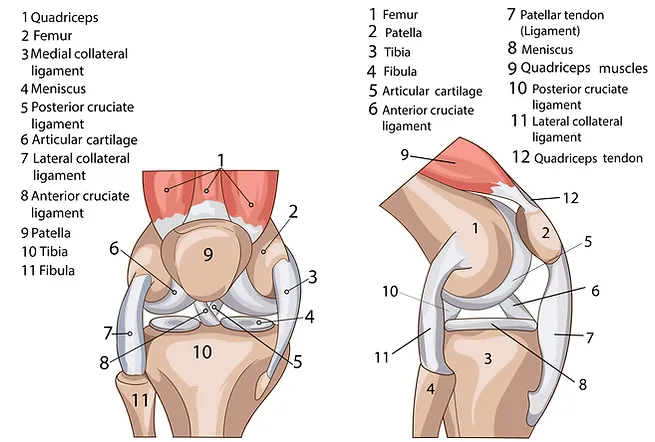
Conditions we treat
Understanding Knee Pain
Knee pain is one of the most common musculoskeletal complaints affecting adults and athletes in New York City. The knee is the largest and one of the most complex joints in the body — a weight-bearing hinge that connects the thigh bone (femur) to the shin bone (tibia), stabilized by ligaments, menisci, cartilage, and a network of muscles and tendons. This combination of mobility and load-bearing responsibility makes the knee vulnerable to a wide range of injuries and degenerative conditions. Whether your knee pain stems from an ACL injury, meniscus tear, arthritis, or overuse, City Integrative Rehabilitation provides expert knee pain treatment in Manhattan using an integrative, evidence-based approach that builds a plan around the likely pain source, contributing factors and functional goals.
Assessment-led care · Manhattan and Great Neck
Acute vs. Chronic Knee Pain
Understanding whether your knee pain is acute or chronic is essential for determining the most effective treatment approach. Acute knee pain develops suddenly — often from a twist, fall, or sports injury — and typically improves within a few weeks with appropriate medical care. Chronic knee pain persists for three months or longer and usually involves deeper structural issues such as osteoarthritis, ongoing meniscal degeneration, or patellofemoral syndrome. The severity of the condition often determines whether conservative treatment alone is sufficient or whether more advanced interventions are needed. Some knee symptoms persist and require reassessment when function is not improving. Our pain doctors evaluate the timeline, mechanism, and pattern of your symptoms to determine the most effective treatment strategy.
Common Symptoms of Knee Pain
Knee pain presents with a variety of symptoms depending on the underlying cause. Recognizing your specific pattern helps our pain specialists provide a more accurate diagnosis and targeted treatment plan. Common symptoms include:
Swelling and visible inflammation
Stiffness — particularly noticeable in the morning or after prolonged sitting
Difficulty bending or straightening the knee fully
Instability or a sensation of the knee “giving way”
Clicking, popping, or grinding sensations during movement
Pain that worsens with stairs, squatting, or kneeling
Locking — the knee gets stuck and cannot fully extend
Pain that increases with activity and improves with rest
Common Causes of Knee Pain
Additional causes include knee bursitis, patellar tendinitis (jumper’s knee), IT band syndrome, Baker’s cyst, rheumatoid arthritis, gout, chondromalacia patella, and sports-related injuries. Hip dysfunction and foot mechanics also frequently contribute to knee pain by altering the forces that pass through the joint during walking and running.
Knee osteoarthritis
Knee osteoarthritis is the most common cause of chronic knee pain, particularly in adults over 50. This degenerative condition occurs when the protective cartilage that cushions the joint surfaces gradually wears away, leading to bone-on-bone contact, inflammation, and progressive joint pain. Osteoarthritis develops slowly and worsens over time, so evaluation and an appropriate management plan may be useful when symptoms affect function.
Meniscus tears
Meniscus tears are among the most frequent knee injuries we treat. The menisci are C-shaped cartilage discs that act as shock absorbers between the femur and tibia. Tears can result from acute twisting injuries — common in sports — or from degenerative changes that accumulate over time. Meniscus tears cause pain, swelling, catching, and sometimes locking of the knee joint.
Ligament injuries
Ligament injuries — including ACL (anterior cruciate ligament), MCL (medial collateral ligament), and PCL (posterior cruciate ligament) tears — are common in athletes and active individuals. These injuries often result from sudden direction changes, pivoting, or direct impact. Ligament damage causes instability, pain, and significant limitations in daily activities and athletic performance.
Patellofemoral syndrome
Patellofemoral syndrome (runner’s knee) develops when the kneecap tracks improperly during movement, causing pain behind or around the kneecap. This condition is particularly common among runners, cyclists, and NYC residents who walk extensively on hard surfaces.
Patellar Tendinopathy and Jumper’s Knee
Pain at the patellar tendon often becomes noticeable with jumping, landing, sprinting, squatting or stairs. Front-of-knee pain may also arise from the patellofemoral joint, fat pad, bursa, quadriceps tendon or other structures, so the treatment plan should follow an evaluation.
CityIR assesses the exact symptom location, jumping and squat tolerance, tendon-loading capacity, recent training changes and whether imaging would change the plan.
Where focused ESWT may fit
When the examination identifies an appropriate persistent, localized patellar-tendon target, CityIR generally favors focused ESWT for depth-specific treatment. Shockwave does not replace progressive loading; the plan still needs to rebuild the capacity required for running, lifting, jumping or sport.
Compare focused and radial shockwave or request a knee evaluation.
Risk Factors for Knee Pain
Several factors increase the likelihood of developing knee problems. Excess body weight is one of the most significant — every additional pound adds approximately four pounds of stress to the knee joint with each step. Age-related cartilage degeneration begins as early as the 40s and accelerates over time. High-impact sports, particularly those involving jumping, pivoting, and sudden directional changes, place tremendous stress on knee structures. Previous knee injury — even a minor sprain — increases the risk of future problems if the underlying dysfunction was not fully addressed. Occupations requiring prolonged standing, kneeling, or stair climbing increase risk. Muscle weakness, particularly in the quadriceps and hip stabilizers, leaves the knee vulnerable to abnormal loading. Poor footwear and biomechanical issues such as flat feet or overpronation alter knee alignment during everyday activities.
How Knee Pain Is Diagnosed
Accurate diagnosis is the foundation of effective knee pain relief. Our doctors begin with a detailed patient history followed by a comprehensive physical examination that includes knee range of motion testing, ligament stability assessment, meniscal provocation tests, patellar tracking evaluation, and gait analysis. We examine the entire kinetic chain — including the hip, ankle, and foot — because dysfunction above or below the knee frequently contributes to knee symptoms. When necessary, we may recommend diagnostic imaging such as X-rays, MRI, or diagnostic ultrasound to visualize ligament tears, meniscal damage, cartilage loss, or other structural abnormalities.
Knee Pain Treatment Options at City Integrative Rehabilitation
Our integrative treatment approach draws from multiple disciplines to provide the most comprehensive knee pain care available in New York City. Every treatment plan is customized to the individual patient based on the specific diagnosis, the severity of the condition, and your functional goals.
Physical Therapy
Physical therapy is the cornerstone of knee pain recovery. Our physical therapists design progressive rehabilitation programs that restore quadriceps and hamstring strength, improve knee stability, and retrain proper movement patterns. Manual therapy techniques address tissue restrictions and restore joint mobility. Therapeutic exercises are progressed systematically from pain-free range of motion to functional strengthening and sport-specific activities.
Sports Chiropractic
Our chiropractors use targeted joint mobilization techniques to restore proper alignment and movement throughout the lower extremity kinetic chain. Pelvic asymmetries, hip restrictions, and ankle joint dysfunction frequently contribute to knee pain by altering how forces are distributed through the joint. Addressing these areas can provide significant pain relief.
Focused shockwave therapy
Extracorporeal shockwave therapy may be considered as an adjunct for selected persistent tendon presentations. CityIR generally favors focused ESWT when the evaluation identifies an appropriate localized, depth-specific target. Progressive loading and activity planning remain central to rebuilding knee capacity.
Dynamic Neuromuscular Stabilization (DNS)
DNS uses developmental kinesiology principles to retrain how the brain controls knee and lower extremity stabilization. DNS may be incorporated when the evaluation identifies relevant stabilization or movement-control goals.
Anatomy in Motion (AiM)
Anatomy in Motion examines how the entire body moves through the gait cycle, identifying global movement dysfunctions that may be overloading the knee. Restrictions in the foot, ankle, or hip frequently drive compensatory stress patterns that manifest as knee pain.
When to Consider Advanced Interventions
For patients with severe pain that has not responded adequately to conservative care, advanced interventional pain management procedures may be appropriate. These minimally invasive procedures target specific pain generators with precision. Corticosteroid injections can reduce inflammation within the knee joint. Viscosupplementation (hyaluronic acid injections) can provide lubrication and cushioning for arthritic knees. Platelet-rich plasma (PRP) injections are an interventional option that may be discussed with an appropriately qualified medical clinician after diagnosis and review of alternatives.
For cases of advanced osteoarthritis or significant structural damage where conservative and interventional approaches have been exhausted, knee replacement surgery may be recommended. Our team works closely with orthopedic surgeons and provides comprehensive pre- and post-surgical rehabilitation to optimize outcomes for patients who undergo total or partial knee replacement.
The Knee-Hip-Ankle Connection
One of the most frequently overlooked factors in knee pain is the relationship between the knee, hip, and ankle. The knee functions as the middle link in a kinetic chain — it is directly influenced by what happens above at the hip and below at the ankle and foot. Weak hip abductors allow the knee to collapse inward during walking and running, placing abnormal stress on the medial structures. Ankle stiffness or flat feet alter how ground forces travel through the lower extremity, often concentrating stress at the knee. At City Integrative Rehabilitation, we evaluate the entire lower extremity together rather than treating the knee in isolation. This approach evaluates the knee alongside relevant hip, ankle and foot findings.
Our Clinic’s Approach: Why Choose City Integrative Rehabilitation
What sets City Integrative Rehabilitation apart is our whole-body approach to knee pain treatment. Rather than simply addressing the site of pain, we examine how your entire body moves and functions to evaluate likely pain sources and contributing factors. Our NYC clinic brings together chiropractors, physical therapists, and rehabilitation specialists who collaborate on every case — sharing findings, adjusting strategies, and coordinating the parts of the plan that fall within their scopes. Located conveniently in Manhattan near Central Park, we make it easy for busy New Yorkers to get the expert medical care they need. We also serve patients from Long Island and the greater NYC metropolitan area.
Our expert team holds advanced certifications in orthopedic rehabilitation, sports medicine, chiropractic neurology, DNS, and Anatomy in Motion. This depth of expertise means you receive a level of care that single-provider clinics simply cannot match. From your first visit, you will receive a thorough evaluation and a clearly explained treatment plan, with your progress monitored at every step.
Insurance and Scheduling Your First Visit
We understand that navigating insurance coverage for knee pain treatment can be confusing. City Integrative Rehabilitation works with a range of insurance arrangements. Our administrative team can verify benefits and eligibility before care. We also offer flexible scheduling options, including early morning and evening appointments, to accommodate the demanding schedules of NYC professionals. New patients can request an appointment by calling our office or using our online booking system. Getting started is simple — early evaluation can clarify the diagnosis, next step and safe activity plan.
At-Home Care and Lifestyle Modifications for Knee Pain
What you do between clinical visits plays a critical role in your recovery. Activity, exercise and lifestyle adjustments may help manage symptoms and improve capacity. Maintaining a healthy body weight reduces the mechanical stress on your knee joint with every step. Low-impact exercises such as swimming, cycling, and walking maintain joint mobility and muscle strength without excessive loading. Strengthening the quadriceps, hamstrings, and hip muscles builds the foundation that protects the knee long-term. Wearing supportive footwear with proper cushioning and arch support protects the knee from ground reaction forces. Avoiding prolonged kneeling, deep squatting, and high-impact activities during recovery protects healing tissues. Our team provides each patient with individualized home exercise programs and activity modification guidance tailored to their specific condition and everyday activities.
Conditions We Treat
Our team specializes in treating a wide range of knee-related conditions, including:
- Knee osteoarthritis
- Rheumatoid arthritis of the knee
- Meniscus tears
- ACL, MCL, and PCL injuries
- Patellofemoral syndrome (runner’s knee)
- Patellar tendinitis (jumper’s knee)
- Knee bursitis
- IT band syndrome
- Baker’s cyst
- Chondromalacia patella
- Gout and pseudogout
- Sports-related knee injuries
- Pre- and post-knee surgery rehabilitation
Frequently Asked Questions About Knee Pain
What is the most common cause of knee pain?
Osteoarthritis is the most common cause of chronic knee pain, particularly in adults over 50. In younger, active patients, meniscus tears, ligament injuries, and patellofemoral syndrome are more frequent. Our pain doctors evaluate each patient individually to identify the specific cause and develop a targeted treatment plan.
Do I need knee replacement surgery?
Not necessarily. Many knee conditions — including early to moderate osteoarthritis — respond well to conservative treatment including physical therapy, chiropractic care, and advanced modalities like shockwave therapy. Knee replacement surgery is typically reserved for cases of advanced arthritis or significant structural damage that have not responded to comprehensive conservative care. Our team focuses on knee preservation strategies first.
Can knee pain come from my hip or foot?
Yes. Hip weakness, ankle stiffness, and foot biomechanical issues can all contribute to knee pain by altering how forces are distributed through the lower extremity. This is why a comprehensive evaluation that examines the entire kinetic chain — hip, knee, ankle, and foot — is essential for accurate diagnosis and lasting results.
How long does knee pain treatment take?
Treatment duration depends on the cause and severity. Acute muscle strains and mild bursitis may resolve in four to six weeks, while chronic conditions like osteoarthritis require longer-term management. Post-surgical rehabilitation typically requires three to six months. Most patients experience meaningful pain relief within the first few weeks of treatment.
What is a meniscus tear and does it require surgery?
A meniscus tear is damage to the C-shaped cartilage disc that cushions the knee joint. Many meniscus tears — particularly degenerative tears in adults over 40 — respond well to conservative treatment including physical therapy and rehabilitation. Surgery is typically considered for larger tears that cause persistent locking, catching, or significant functional limitations that do not improve with conservative care.
CITYIR LOCATIONS
Choose Your CityIR Location
Knee evaluation and rehabilitation are available in Manhattan. Great Neck offers chiropractic care.
Manhattan
(646) 256-9513
Evaluation, sports chiropractic, rehabilitation, and Manhattan-only advanced treatment options.
Great Neck
(516) 418-3798
Chiropractic care for Great Neck and Nassau County.
Ready to start your recovery? · Get expert treatment in NYC
Don’t let knee pain keep you from the activities you love.
City Integrative Rehabilitation offers expert knee pain treatment in Manhattan using advanced, non-surgical techniques. Schedule your consultation today and take the first step toward recovery.
Book an AppointmentView All Conditions We Treat | Learn About Shockwave Therapy
Great Neck: (516) 418-3798Manhattan: (646) 256-9513Huntington: (631) 659-2980Nesconset: (631) 584-8783