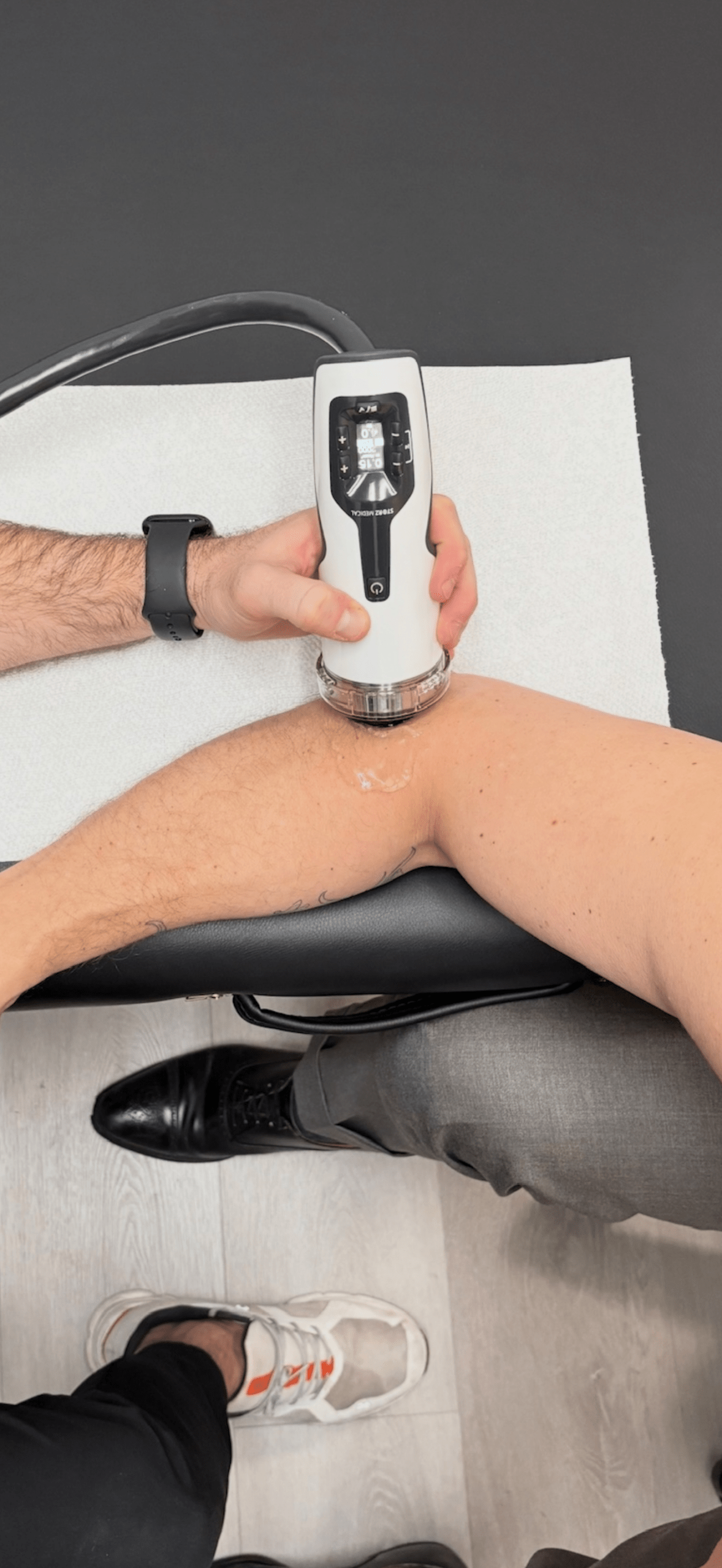
Shockwave Therapy

One of NYC's Most Experienced Focused Shockwave Practices.

Non-invasive pain relief and tissue regeneration for chronic tendon, joint, and soft-tissue conditions. Available at our Manhattan and Great Neck locations.

Book an Appointment

Experience Matters

A Decade of Clinical Shockwave Expertise

Shockwave therapy is only as effective as the clinician delivering it. We've been delivering focused and radial ESWT since 2015 — long before most clinics adopted the technology — across every major tendon, joint, and soft-tissue condition.

Since 2015
Delivering focused and radial ESWT before most clinics adopted it
Both Modalities
Focused and radial in-house — most clinics only offer one
Face to Foot
Every major musculoskeletal condition — shoulder, spine, elbow, hip, knee, foot, plus face and jaw

What It Is

What Is Shockwave Therapy — and When Should You Consider It?

Chronic musculoskeletal conditions like tendonitis, plantar fasciitis, and tennis elbow can resist traditional treatments. Shockwave therapy uses targeted acoustic energy to penetrate deep into tissue — reaching areas other methods simply cannot — and stimulating your body's natural healing response at the cellular level, including the activation and recruitment of mesenchymal stem cells that drive tissue repair and regeneration.

Also known as extracorporeal shockwave therapy (ESWT) or acoustic wave therapy, this non-invasive treatment has been used in orthopedic and sports medicine for over two decades. It's increasingly recommended as an alternative to surgery and cortisone injections, particularly when conservative treatments like physical therapy have reached their limits.

At CityIR, we use both focused and radial ESWT — the two most clinically validated forms of shockwave technology available. Each patient gets a personalized treatment plan tailored to their condition, recovery goals, and activity level. Shockwave therapy is available at our Manhattan and Great Neck locations.
The Difference

Shockwave Activates Your Body's Own Stem Cells

Unlike cortisone injections that mask pain or anti-inflammatories that slow healing, focused shockwave triggers your body's mesenchymal stem cells — the cells responsible for rebuilding damaged tissue. Peer-reviewed research shows ESWT enhances stem cell proliferation, migration, and differentiation at the injury site, which is why patients don't just feel better — they heal.

The Science

How Does Shockwave Therapy Work?

A handheld device delivers high-energy acoustic waves into the treatment area. These pressure pulses activate your body's own stem cells, increase blood flow, break down calcifications, and remodel collagen — driving real tissue regeneration, not just pain relief.

01

Stimulates Blood Flow

Acoustic waves increase microcirculation to the affected area, delivering oxygen and nutrients that accelerate tissue repair. Clinical research calls this neovascularization.

02

Breaks Down Calcification

Focused pressure waves dissolve calcium deposits and scar tissue that contribute to chronic pain, restoring mobility and range of motion.

03

Activates Stem Cells

Shockwaves stimulate your body's mesenchymal stem cells and natural repair mechanisms — triggering collagen remodeling and real tissue regeneration at the injury site, not just masking the pain.

See It In Action

Shockwave Therapy in Practice

Watch how radial and focused ESWT are applied during a typical treatment session.

Radial Shockwave (rESWT)
Focused Shockwave (fESWT)

Why CityIR

Why Choose Shockwave Therapy at CityIR?

Non-invasive with no downtime

No surgery, no injections, no medications. Walk in, get treated, and return to your day immediately.

Treats chronic conditions at the source

Unlike pain medications that mask symptoms, ESWT addresses the underlying tissue damage causing your pain. By promoting cellular repair and regeneration, shockwave delivers lasting results.

Clinically proven

Extensive peer-reviewed research supports shockwave for plantar fasciitis, tennis elbow, rotator cuff tendinopathy, calcific shoulder tendinitis, and more.

Experienced, specialized providers

Our team has extensive training in focused shockwave technology and tailors every treatment — and we've been doing it longer than most clinics in the region.

Real Outcomes

Shockwave Case Studies from Our Practice

Representative patient outcomes from our Manhattan and Great Neck clinics. Names and identifying details have been changed for privacy.

Plantar Fasciitis

Back on the court after 8 months of heel pain

Patient: "Maria," 47, pickleball player

The problem: Sharp heel pain for 8 months after ramping up to pickleball 4–5 times a week. Pain was forcing her to cut games short and ice afterward. She'd already tried orthotics, a cortisone injection, and months of stretching.

The decision: Her podiatrist mentioned plantar fascia release surgery as the next step. She wanted a non-surgical option first.

The treatment: 5 sessions of focused shockwave to the plantar fascia origin, paired with corrective gait work.

Outcome: Pain-free within 4 weeks. Back on the court playing full sessions without icing afterward.

Tennis Elbow

Relief after 6 months of failed treatments

Patient: "David," 52, financial services executive, Midtown

The problem: Lateral elbow pain for 6 months. Typing, mousing, and carrying his briefcase had become painful. He'd tried rest, NSAIDs, a tennis elbow strap, and two months of physical therapy with no improvement.

The decision: His orthopedist recommended a PRP injection. He wanted to try a non-injection option first.

The treatment: 6 sessions of focused shockwave on the lateral epicondyle plus eccentric loading exercise.

Outcome: Full resolution. Returned to a normal workday and weekend tennis without restriction.

Patellar Tendinopathy

Back to league basketball after a year of knee pain

Patient: "Alex," 34, recreational basketball player

The problem: Chronic patellar tendon pain for over a year. He was limited to pickup games only, and even those required ice and ibuprofen afterward. He'd done 4 months of PT with partial improvement that plateaued.

The decision: He wanted to get back to competitive league play without managing pain around every game.

The treatment: 4 sessions of focused shockwave targeting the patellar tendon, combined with a progressive loading program.

Outcome: Returned to full league play within 6 weeks, pain-free. No recurrence in the 8 months since.

Partial Rotator Cuff Tear

Surgery recommended. Surgery avoided.

Patient: "Robert," 58, recreational golfer, Great Neck

The problem: Right shoulder pain for over a year. MRI confirmed a partial supraspinatus tear. His orthopedic surgeon recommended arthroscopic repair with a 4–6 month recovery.

The decision: He wanted to exhaust non-surgical options before committing to surgery and a long recovery away from the course.

The treatment: 6 sessions of focused shockwave to the supraspinatus and rotator cuff, combined with targeted scapular stabilization work.

Outcome: Pain resolved, overhead range of motion restored. Follow-up with his surgeon confirmed surgery was no longer indicated. Back to playing golf without restriction.

Individual results vary. The case studies above are representative of outcomes we've seen in our practice and are not a guarantee of specific results. Treatment plans are customized based on diagnosis, imaging, and individual response to care.

Focused shockwave therapy applied to the lateral epicondyle for tennis elbow relief

What to Expect

What to Expect During Shockwave Treatment

01

Diagnosis & Assessment

We evaluate your condition and determine if shockwave is the right approach, following evidence-based protocols.

02

Treatment Sessions

Typically 4-6 sessions, each 15-20 minutes. Mild discomfort is normal; no anesthesia needed.

03

No Recovery Time

Return to normal activities immediately. Most patients resume exercise within 24-48 hours.

04

Progressive Improvement

Some patients notice improvement immediately, while others begin to feel relief within 2-3 sessions. Full results develop over 6-12 weeks.

What We Treat

Conditions Shockwave Therapy Treats

Stimulating your body's own repair process for lasting recovery — not just pain relief.

Tendon Injuries & Tears

  • Rotator cuff tears (partial)
  • Achilles tendinopathy
  • Tennis elbow (lateral epicondylitis)
  • Golfer's elbow (medial epicondylitis)
  • Patellar tendinitis (jumper's knee)
  • Bicipital tendinitis

Muscle & Soft Tissue

  • Muscle strains & partial tears
  • Trigger points
  • Myofascial pain syndrome
  • IT band syndrome
  • Hamstring injuries
  • Quadriceps & calf strains

Chronic Pain Conditions

  • Frozen shoulder (adhesive capsulitis)
  • Plantar fasciitis
  • Shin splints
  • Chronic neck & back pain
  • Non-healing stress fractures
  • Chronic tendinosis

Bursitis

  • Hip bursitis (trochanteric)
  • Shoulder bursitis (subacromial)
  • Knee bursitis
  • Elbow bursitis (olecranon)
  • Retrocalcaneal bursitis
  • Iliopsoas bursitis

Calcifications

  • Calcific shoulder tendinitis
  • Calcium deposits in tendons
  • Heterotopic ossification
  • Bone spurs (plantar, heel)
  • Insertional Achilles calcifications
  • Patellar tendon calcifications

Joint Conditions

  • Knee osteoarthritis
  • Hip arthritis
  • Early cartilage degeneration
  • Post-surgical scar tissue
  • Ankle & foot arthritis
  • SI joint dysfunction

And many more. We treat a wide range of conditions with ESWT — if yours isn't listed here, call or text us to find out if shockwave is right for you.

Not sure if shockwave is right for your condition?

Call or text either of our offices right now to see if you qualify — no pressure, just answers.

Focused shockwave therapy treatment for bicipital tendinitis
Shockwave therapy targeting the bicipital tendon for chronic shoulder pain

Treatment Options

Shockwave vs. Surgery vs. Injections

See how focused shockwave compares to traditional treatments for the most common musculoskeletal conditions.

ConditionShockwave TherapySurgeryCortisone Injections
Partial Rotator Cuff Tear3–6 sessions. 8–12 weeks to healing. Minimal downtime.Surgery + 4–6 months recovery. Risk of scar tissue, infection.Temporary relief. Repeated injections weaken tendons.
Plantar Fasciitis3–6 sessions. Walk same day. High long-term success rate.Fascia release + 6–10 weeks non-weight-bearing.Short-term relief. Risk of fat pad atrophy.
Tennis Elbow3–5 sessions. Return to activity quickly.Surgery + 4–6 months recovery.Studies show worse long-term outcomes vs. no treatment.
Calcific Shoulder Tendinitis3–6 sessions. Breaks down calcium non-invasively.Arthroscopic removal + months of rehab.Cannot dissolve calcifications.
Achilles Tendinopathy4–6 sessions. Stimulates collagen remodeling.Surgical debridement + 3–6 months recovery.High risk — increases rupture risk.
Joint Arthritis (Knee/Hip)4–6 sessions. Stimulates cartilage repair.Joint replacement + 3–6 months recovery.Temporary relief. May accelerate cartilage breakdown.

Investment

Insurance & Payment

Transparent Pricing

Every cost is discussed upfront before treatment begins. No surprise bills, no hidden fees — you'll know exactly what your care looks like before you commit.

Flexible Payment Plans

Shockwave is offered as a cash-based service with flexible payment options. Contact our office to learn about pricing — no pressure, no commitment required.

Questions & Answers

Frequently Asked Questions

Most patients describe a mild tapping or pressure sensation. Healthy tissue with no inflammation typically feels little to nothing, while the affected area responds more. Intensity is fully adjustable throughout your session. No anesthesia is needed.
Most conditions respond well to 3-6 sessions, typically once per week. Your provider will recommend a plan based on your specific diagnosis.
Some patients notice improvement after 1-2 sessions. Full healing takes 6-12 weeks as new tissue forms and strengthens.
Side effects are minimal and may include temporary redness, mild swelling, or soreness at the treatment site. These typically resolve within 24-48 hours.
In many cases, yes. ESWT is often recommended as a conservative alternative before surgery, with high success rates for chronic tendon conditions.
No. Therapeutic ultrasound uses continuous, low-intensity waves to warm tissue. Shockwave (ESWT) delivers high-energy acoustic pressure pulses that penetrate deep into tissue, triggering real biological repair — new blood vessels, stem cell activation, breakdown of calcifications. Different mechanism, different outcomes.
No. A TENS unit sends low-voltage electrical impulses to temporarily block pain signals — short-term symptom relief only. Shockwave uses acoustic (mechanical) energy to stimulate actual tissue regeneration and long-term healing.

Is This Right For You?

Who Is a Good Candidate for Shockwave?

Shockwave is best for patients with chronic musculoskeletal pain that hasn't responded to more conservative approaches.

You're likely a candidate if:

  • You've had persistent heel pain, shoulder stiffness, or tendon discomfort for more than six weeks
  • You've tried rest, physical therapy, or anti-inflammatory medication without lasting relief
  • You've had cortisone injections that only worked short-term — or you want to avoid them
  • You're looking to avoid surgery and want a non-invasive option
  • You're an active adult or athlete recovering from sports injuries
  • You have Achilles tendonitis, plantar fasciitis, tennis elbow, calcific shoulder tendinitis, patellar tendinopathy, or chronic hip bursitis

How our evaluation works:

01
Medical history review
We go through your history, past treatments, and current symptoms in detail — no rushed intake.
02
Movement & pain assessment
Range of motion, stability, and pain-pattern testing to identify what's driving your symptoms.
03
Imaging if needed
Ultrasound or MRI may be ordered to confirm diagnosis before treatment begins.
04
Personalized treatment plan
Typically 3–6 sessions spaced one week apart, designed around your condition and recovery goals.
What to expect from here: Most patients notice progressive improvement after the second or third session, with full results continuing to develop over 8 to 12 weeks as tissue remodeling takes place. Our goal is to restore function, reduce inflammation, and improve your quality of life — not just mask the pain.

Ready to Start

Ready to find out if shockwave is right for you?

Book online or call either of our shockwave locations to speak directly with our team. Shockwave therapy is available at our Manhattan and Great Neck clinics.

Book an Appointment